Handmade in Calgary by pet parents, for pet parents. Named after our cats, Coffee & Cookie. 🐾
Laser Engraved vs. Printed Pet Keepsakes: Which One Truly Lasts a Lifetime?
When you’re choosing a memorial for a pet you loved, the laser engraved vs printed question matters more than it might seem — because you’re not just choosing a product. You’re choosing something to outlast the grief — something that will still be on your shelf in ten years, in twenty, passed down perhaps to someone who never met the animal but knows the name.
The last thing you want is to open a box six months later and notice the ink beginning to lift at the edges. Or to take your memorial coaster off the windowsill one afternoon and find the portrait has faded in the sun.
This happens. It happens with printed keepsakes more often than the people selling them will tell you. And it’s worth understanding why — before you spend money on something meant to last forever.
How Printed Keepsakes Work (and Why They Don’t Last)
Printed pet keepsakes — whether produced by UV printing, sublimation, or direct-to-surface inkjet methods — share a fundamental characteristic: the image sits on top of the material, not inside it.
In UV printing, ink is applied to the surface and cured with ultraviolet light, creating a thin hardened layer. In sublimation, dye is transferred via heat onto a polymer-coated surface, where it bonds to the coating — not to the material beneath. In both cases, the result is visually rich: full colour, photographic detail, the ability to reproduce complex tonal gradients in a portrait.
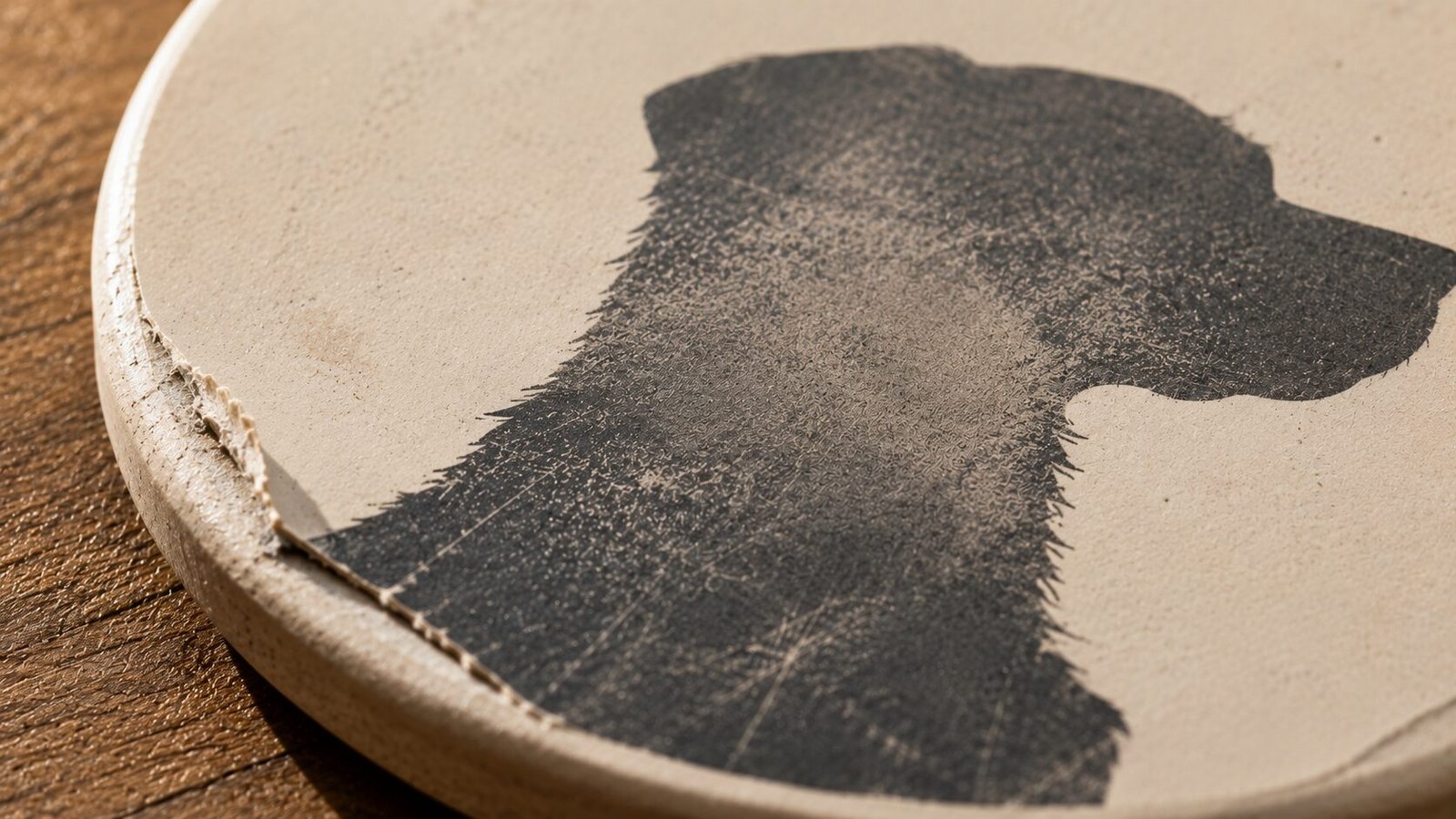
But the mechanism is also its weakness. Because the image exists as a surface layer, it is subject to every form of surface degradation:
- UV exposure from sunlight or indoor lighting causes dye molecules to break down over time, fading colours — particularly in blues, greens, and reds — within two to five years of regular light exposure
- Moisture and humidity can cause sublimated coatings to lift, bubble, or crack, especially on rigid surfaces like slate or wood
- Daily handling gradually abrades the surface layer — each touch, each cleaning, each contact with another surface removes a fraction of the ink
- Temperature fluctuation causes materials to expand and contract at different rates than their coatings, eventually causing delamination and peeling
A beautifully printed pet portrait on a ceramic mug or wood plank may look extraordinary on day one. By year five, under normal use and light exposure, it is unlikely to look the same.
How Laser Engraving Works (and Why It Lasts Indefinitely)
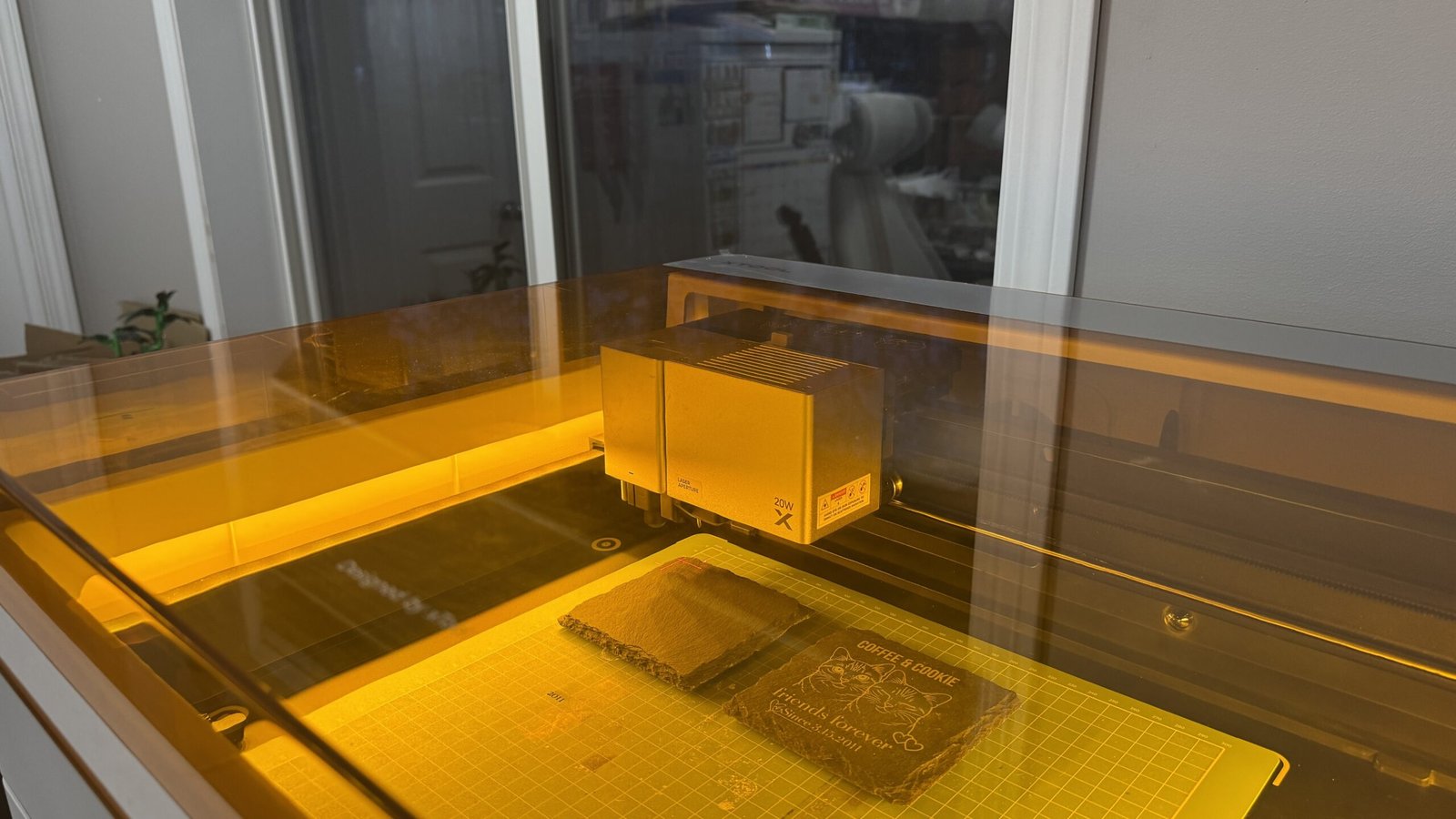
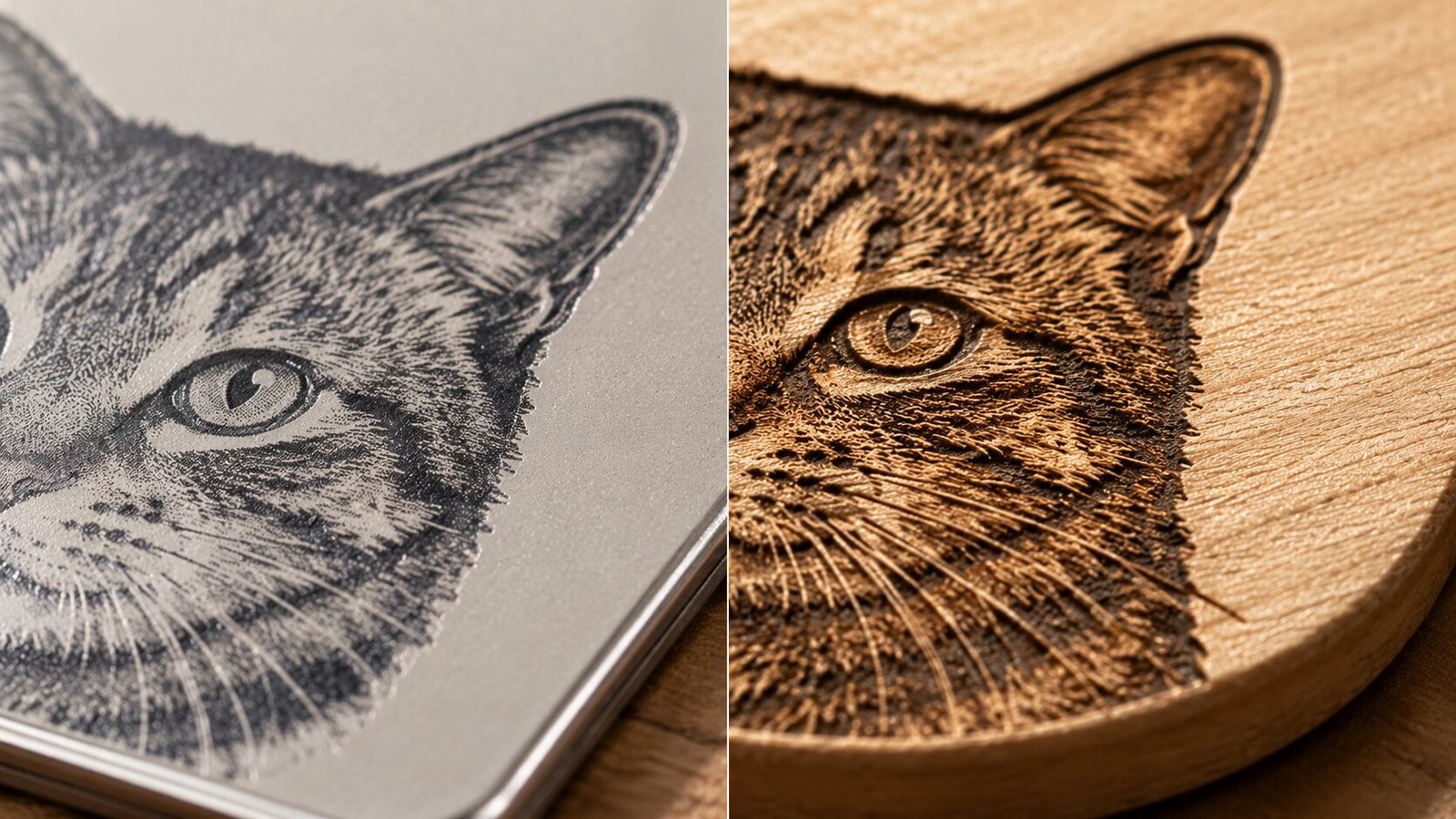
Laser engraving works on an entirely different principle. Rather than applying anything to the surface, a calibrated laser beam permanently alters the material itself — vaporising or charring the top layer of wood, scoring the crystalline structure of slate, or oxidising the surface of metal to create a colour change.
The result is a recess — a physical depression in the material, tactile under your fingertip, that exists not as a coating on top of the object but as a changed state of the object itself.
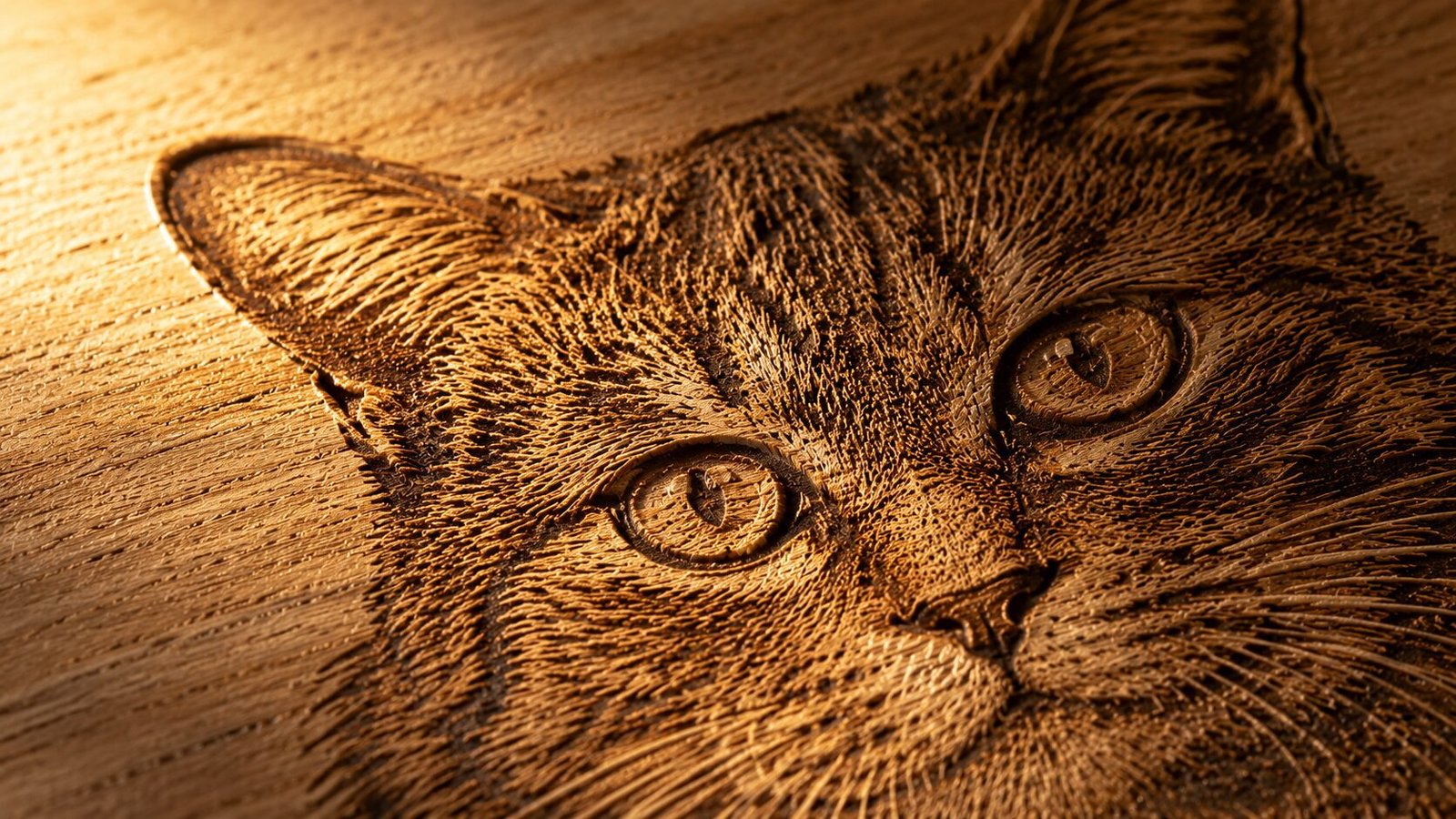
This distinction is the entire argument:
There is nothing to fade because there is no pigment. The dark lines of a laser-engraved wood portrait are darkened wood fibres. The crisp text on a slate coaster is scored slate. The detail on an engraved metal piece is the metal itself, altered at a microscopic level. No dye degrades. No ink peels. No coating lifts.
There is nothing to scratch off because there is no surface layer. Abrasion affects the surrounding material uniformly — which is to say, very slowly, in the way that any quality material weathers over decades. The engraving itself is as durable as the object it’s part of.
UV light has no effect on the engraving. Because the contrast comes from the material’s own altered structure rather than from pigment molecules, sunlight cannot cause fading. A laser-engraved wooden shadow box placed beside a window will look identical in ten years to how it looks today.
This is why laser engraving has been used for permanent signage, architectural work, and awards for decades. It is not a new technology being adapted for novelty. It is the established standard for anything that must remain legible and beautiful for a very long time.
Side-by-Side Comparison
| Factor | Printed (UV/Sublimation) | Laser Engraved |
|---|---|---|
| Longevity | 2–7 years before visible degradation | Indefinite — decades with normal care |
| UV / sunlight resistance | Poor — colours fade with light exposure | Excellent — no pigment to degrade |
| Moisture resistance | Low — coatings can lift, bubble, or crack | High — engraving is part of the material |
| Tactile quality | Flat, surface-level — no texture to touch | Deep, tactile recess — feels as well as looks engraved |
| Scratch / abrasion resistance | Low — surface layer wears with handling | High — no surface layer to remove |
| Colour reproduction | Full colour photographic detail | Monochromatic tonal range (wood grain adds warmth) |
| Outdoor / display resilience | Not recommended for bright or humid environments | Excellent for indoor display; slate suitable outdoors |
| Maintenance required | Requires careful handling and storage | None — clean with a dry cloth as needed |
| Best suited for | Short-term display, low-handling contexts | Permanent memorials intended to last a lifetime |
What This Means for Your Memorial
At Coffee & Cookie Design, we chose laser engraving deliberately — and we made that choice before we made our first product.
Our customers are entrusting us with something irreplaceable: a photo of an animal they will never be able to photograph again, a name that matters more than we can fully know, dates that mark the beginning and end of a relationship that shaped them. The obligation that comes with that trust is one we take seriously.

This is why we choose laser-engrave:
- Our 5-layer wooden Shadow Boxes feature a laser-engraved portrait burned into natural wood grain — the image is part of the wood now, not printed on top of it. It will look the same in thirty years.
- Our slate and cork coasters are scored with precision laser engraving that is as durable as the slate itself — dishwasher safe, sunlight safe, and unaffected by daily use.
- Our memorial jewellery uses laser engraving and oxidisation techniques on metal surfaces, creating details that won’t rub off against skin or clothing over years of daily wear.
You are not buying something beautiful for now. You are buying something that will still be beautiful when you are the one who has to explain to someone younger who it was, and why they mattered.
That piece needs to be intact when that moment comes.
A Note on Colour
The honest trade-off of laser engraving is colour: because the technique works by altering the material rather than applying pigment, the result is monochromatic — warm wood tones and charred lines rather than full photographic colour.
For some customers, this is a dealbreaker, and that’s a fair preference. But for many — and we have found this to be the majority of people ordering memorial pieces — the engraved wood aesthetic feels right in a way that a printed colour photo does not. It feels like art rather than a reproduction. It feels considered. It feels like something that was made for a specific person, by hand, over time.
The warmth of the wood grain visible through the portrait is not a limitation. It is the material speaking.
If permanence matters to you — and for a memorial, it should — the laser engraved vs printed choice has a clear answer: laser engraving is not just the better option. It is the only one worth choosing. If you’re searching for a permanent memorial to give someone who is grieving, our pet sympathy gift guide walks through the full range of handmade options — from smaller everyday keepsakes to the shadow box itself.
— Michelle, Evan, Coffee & Cookie
Coffee & Cookie Design · Calgary, Alberta · coffeencookiedesign.com
Made to remember. Crafted with love.