Handmade in Calgary by pet parents, for pet parents. Named after our cats, Coffee & Cookie. 🐾

Pet Loss and Children: How to Explain the Death of a Pet to Kids of Any Age

Pet loss and children is one of the hardest combinations a parent faces — your own grief, and theirs, arriving at the same time. You are already grieving. And now you have to find words.
When a family pet dies, parents often carry a doubled weight: their own loss, and the task of helping their children through theirs. There is no perfect way to do this. But there are approaches that help and ones that don’t — and knowing the difference makes a real difference to a child.
A pet’s death is, for many children, their first direct encounter with mortality. The way it is handled — honestly, gently, without false comfort — shapes not just how they process this loss, but how they understand death for the rest of their lives. That is not pressure. It is permission to take it seriously. If you are also in the first days of your own grief, our guide to the first week of grief may be a gentle companion alongside this one.
Age-By-Age Guidance
Toddlers and Preschoolers (Ages 2-5)
Very young children do not yet understand that death is permanent. They may ask where the pet is repeatedly, or seem to accept the news and then ask again the next day. This is developmentally normal.
Use concrete, honest language. Say the pet has died — not that they went to sleep, went away, or were lost. Euphemisms intended to soften the blow often create new fears: a child told their dog went to sleep may begin to fear bedtime. A child told their cat went away may wait for them to return.
Simple, true sentences work best: “Biscuit died. That means his body stopped working and he won’t come back. We are sad because we loved him.”
Allow them to feel whatever they feel. Some small children will cry. Others will ask if they can have a snack. Both are normal. If your child asks what happens after a pet dies, our guide to pet loss and healing explains the Rainbow Bridge concept in a way that many families have found comforting.
School-Age Children (Ages 6-12)
Children in this age group understand that death is permanent, that it will happen to everyone eventually, and that they themselves will die one day. This awareness can make pet loss more frightening than it appears.
They may also experience guilt. Did I play with her enough? Was it my fault she got sick? These thoughts are extremely common and should be addressed directly: “You did not cause this. Nothing you did or didn’t do made this happen.”
School-age children benefit from involvement. Being part of a small ceremony, helping choose a memorial, or having a dedicated space to grieve gives the loss somewhere to go.
Tweens and Teenagers (Ages 12+)

Older children may grieve more privately, or more intensely, than younger ones — and sometimes both at once. A teenager who seems unaffected may be processing quietly, or may feel that grief over a pet isn’t legitimate enough to show.
Do not minimise. “You’ll be fine” or “It’s just a pet” — even said gently — communicates that the grief isn’t worth taking seriously. Instead: “I know how much you loved her. This is real, and it makes sense that it hurts.”
Give them space and keep the door open. Check in without pushing.
What Not To Say — And What To Say Instead
Avoid: “We put them to sleep” — creates fear of sleep. Say: “The vet helped them die peacefully.”
Avoid: “God took them” — can make God seem threatening. Say: “Their body stopped working.”
Avoid: “They ran away” — creates false hope. Say: “They died — they won’t be coming back.”
Avoid: “They’re in a better place” — abstract. Say: “We don’t know what happens, but they aren’t in pain.”
Avoid: “Don’t cry, they’re happy now” — shuts down emotion. Say: “It’s okay to cry. I’m crying too.”
Honesty, even when it’s hard, is more protective than comfort that isn’t true.
If you’re also supporting a friend whose family has lost a pet, our guide to what to say when a pet dies has fifteen copy-pasteable messages for adults too.
Should You Let Children Be Present At Euthanasia?
This is one of the most genuinely contested questions in pet loss guidance, and the honest answer is: there is no universally right choice.
The case for inclusion: Children who are present often report, in retrospect, that being there gave them closure. They saw that their pet died peacefully, surrounded by people who loved them. Many child psychologists suggest that, with preparation and parental presence, attendance can be appropriate for children over roughly seven or eight.
The case for exclusion: Euthanasia can be distressing even for adults who are prepared for it. A child who is not ready may find the experience traumatic rather than comforting. Younger children often do better saying a private goodbye before.
Prepare honestly. Explain what will happen before you go. Ask the child what they want, without pressure. And follow your instinct about your specific child — you know them best.
For parents navigating their own feelings around the euthanasia decision, our post on guilt after pet euthanasia addresses the weight that decision carries.
Practical Ways To Include Children In The Memorial
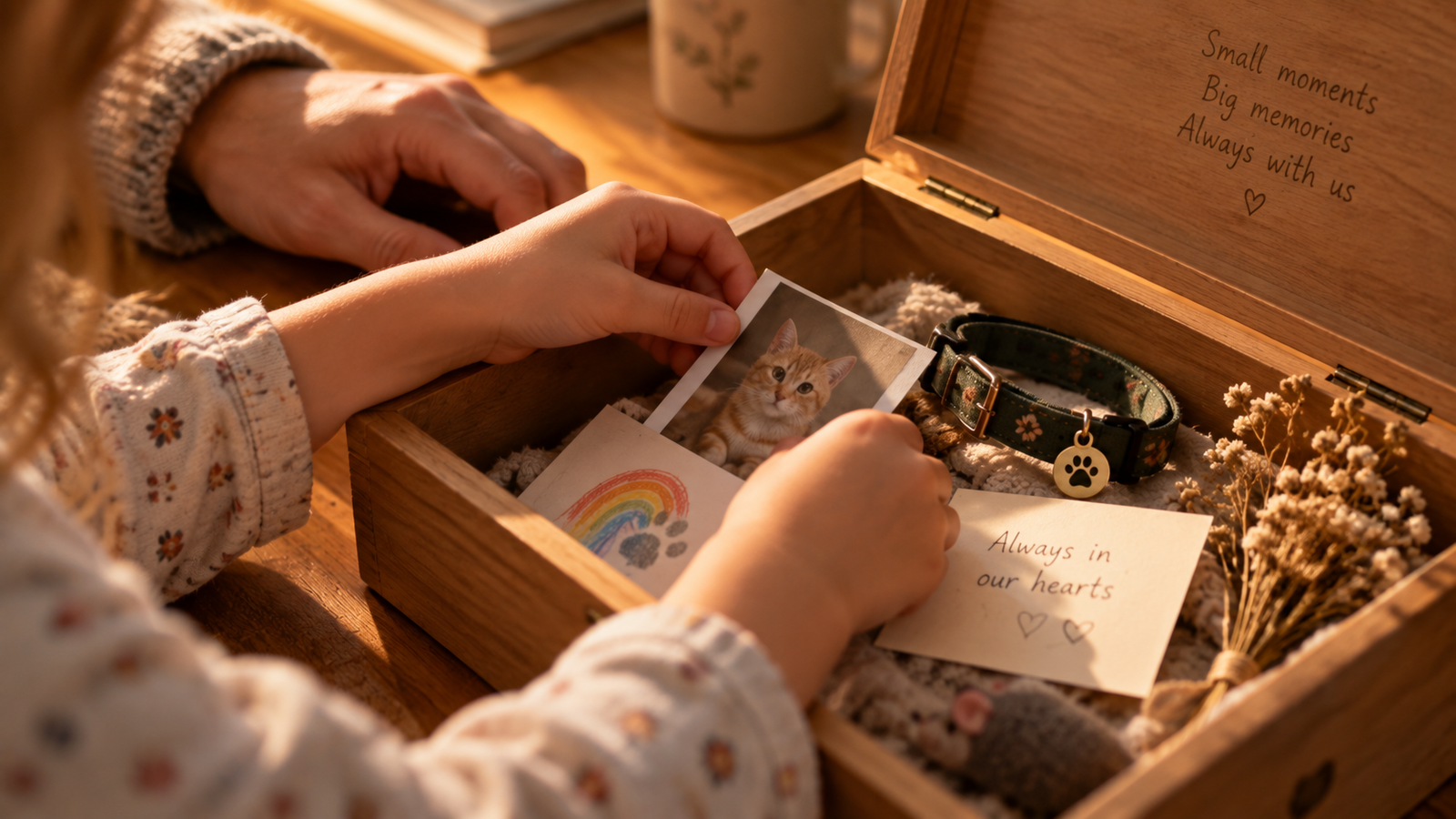
Children grieve through doing. Giving them something concrete and meaningful to participate in helps the grief move rather than stay stuck.
Let them choose a keepsake. A small engraved coaster, a keychain, or a shadow box — letting a child help select or contribute to the memorial gives them ownership of the remembrance.
Help decorate a memory box. A shoebox or small wooden box can become a dedicated space: a photo, a collar, a favourite toy, a drawing. The act of building it together is the ritual. For families who want to build something more lasting, our guide to creating a pet memorial shelf at home has ideas that children can help set up and tend.
Draw a portrait. Ask children to draw the pet as they remember them. Frame it or keep it in the memory box.
Write a letter to the pet. Even children who can’t write yet can dictate. “Dear Biscuit, I miss you. I liked when you slept on my feet.”
Mark the day. Light a candle on the anniversary. Visit the spot where ashes were scattered or a plant was planted. A recurring small ritual gives children an annual structure for grief. Our guide to meaningful pet memorial rituals has ideas that work for families.
When A Child’s Grief Needs More Support
Most children move through pet loss with time, honesty, and parental presence. But some signs suggest a child may benefit from speaking to a professional:
- Persistent sleep disturbance beyond two to three weeks
- Refusing to eat, go to school, or engage with friends
- Repeated expressions of intense guilt that don’t respond to reassurance
- New fears or anxieties that weren’t present before the loss
- Significant withdrawal or emotional shutdown
- Talking about wanting to die, or joining the pet
If several persist, or if your instinct tells you something is wrong, trust it. Our guide to pet loss support resources in Calgary and Alberta includes local options for families.
You Are Doing It Right By Being Here
Navigating pet loss and children well doesn’t require perfect words — it requires honesty and presence, which you’re already offering by being here. The fact that you searched for this already tells us something about you. You are trying to do this well. That is what your child will remember: not the perfect words, but that you showed up with honesty, that you cried in front of them and said it was okay to cry, that you took their grief seriously because it was.
When children are ready to have something lasting — a small engraved keepsake they helped choose, a shadow box that holds the pet’s photo on a shelf they can visit — it can give their grief a permanent, beautiful home. We make those things here in Calgary, one at a time. Our messages are always open.
— Michelle, Evan, Coffee & Cookie
Coffee & Cookie Design · Calgary, Alberta · coffeencookiedesign.com
Made to remember. Crafted with love.